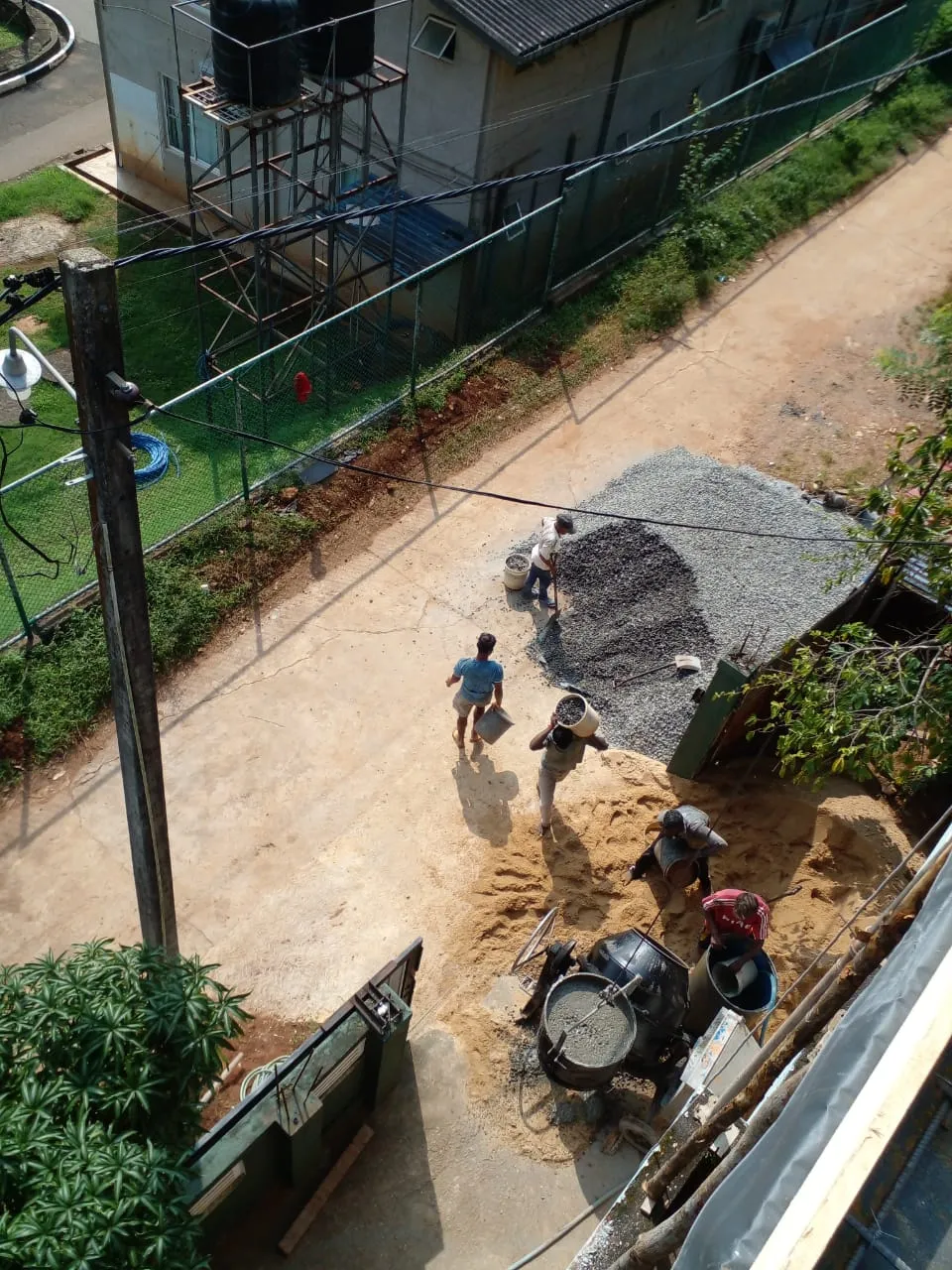
The foundation is the most important part of your house. Get it right and your home stands strong for 50+ years. Get it wrong and you face cracked walls, uneven floors, and structural problems that cost lakhs to repair.
Yet many homeowners in Sri Lanka leave the foundation decision entirely to their contractor without understanding the options. The soil under your land in Matale is completely different from Colombo or Dambulla, and each requires a different foundation approach.
This guide explains every foundation type used in Sri Lankan house construction, when to use each one, what they cost, and how to make the right choice for your land.
Why the Foundation Matters More Than Anything Else
Your foundation carries the entire weight of the house — walls, roof, furniture, and people — and transfers it safely to the ground. If the soil cannot handle this weight, or if the foundation is the wrong type, the house settles unevenly. This causes:
- Cracked walls — diagonal cracks that worsen over time
- Stuck doors and windows — frames shift as the structure moves
- Water seepage — gaps form where water enters
- Structural failure — in extreme cases, partial collapse
Foundation work accounts for 10-15% of total construction cost (Rs. 2,500–5,000 per sq ft). Spending a little more on the right foundation saves you from spending a lot more on repairs later. This is one of the most common mistakes homeowners make — choosing the cheapest foundation instead of the correct one.
The 5 Foundation Types Used in Sri Lanka
1. Strip Foundation (Most Common)
A strip foundation is a continuous strip of concrete that runs under all load-bearing walls. It is the most traditional and widely used foundation type for houses in Sri Lanka.
| Feature | Detail |
|---|---|
| Best for | Single and two-storey houses on stable ground |
| Soil requirement | Good bearing capacity, stable soil |
| Typical depth | 900mm–1,200mm below ground level |
| Cost | Rs. 2,500–4,000 per sq ft (cheapest option) |
| Width | Usually 600mm–900mm depending on wall load |
How it works: A trench is dug along the wall lines, filled with mass concrete (Grade 15), then reinforced concrete (Grade 20 or 25) is poured on top to form the footing. Block or brick walls are built up from the footing to ground level, and a DPC (Damp Proof Course) is applied before the superstructure begins.
Pros: Cheapest foundation type, simple construction, well-understood by all Sri Lankan masons, uses less concrete than raft foundations.
Cons: Not suitable for weak soil, high water tables, or land with variable soil conditions. If soil bearing capacity differs across the site, the house will settle unevenly.
Best for: Most houses in Kurunegala, Galhinna, and flat areas of Matale where soil is stable and ground is relatively level.
2. Raft (Mat) Foundation
A raft foundation is a single, thick concrete slab (typically 150mm–300mm) that covers the entire footprint of the house. It spreads the building load over the maximum area.
| Feature | Detail |
|---|---|
| Best for | Weak soil, variable soil conditions, modern houses |
| Soil requirement | Works on weak and variable soil |
| Typical depth | 150mm–300mm slab thickness |
| Cost | Rs. 2,700–4,600 per sq ft (8-16% more than strip) |
| Concrete grade | Grade 20 or 25 with steel mesh reinforcement |
How it works: The entire building footprint is excavated to a uniform depth. A layer of compacted hardcore and sand blinding is laid, followed by a waterproof membrane, then the reinforced concrete slab is poured in one go. Walls and columns are built directly on top of this slab.
Pros: Distributes load evenly, reduces differential settlement, acts as a ground floor slab (saving money on separate floor construction), good for weak soils.
Cons: Uses more concrete and steel than strip foundations, requires proper engineering design (additional cost for structural engineer), not suitable for very weak soil that needs deep foundations.
Best for: Houses in low-lying areas of Colombo, areas with variable soil, and any site where the soil test shows inconsistent bearing capacity across the footprint.
3. Pile Foundation
Pile foundations use long concrete columns (piles) driven or bored deep into the ground until they reach a strong soil layer or bedrock. They transfer the building load to deep stable soil, bypassing weak surface layers.
| Feature | Detail |
|---|---|
| Best for | Very weak soil, waterlogged land, coastal areas |
| Soil requirement | Weak surface soil with strong layers deeper down |
| Pile depth | 3m–15m+ depending on stable layer depth |
| Cost | 2–3x the cost of strip foundations |
| Pile sizes | 300mm, 450mm, 500mm diameter (residential) |
Types of piles used in Sri Lanka:
- Bored cast-in-situ piles — A hole is drilled into the ground, a steel cage is inserted, and concrete is poured. Most common for residential use.
- Micro piles (mini piles) — Smaller diameter piles (150mm–300mm) for lighter structures or restricted access sites. More cost-effective for houses.
- Driven piles — Pre-cast concrete piles hammered into the ground. Used for larger projects but can cause vibration damage to nearby structures.
Pros: Only option for very weak surface soil, transfers load to deep stable layers, works in high water table conditions, suitable for coastal and marshy land.
Cons: Most expensive foundation type, requires specialized equipment and contractors, longer installation time, needs detailed soil investigation to determine pile depth.
When you need piles: If your soil test shows weak bearing capacity in the top 2-3 metres, or if your land is near a river, lake, or coast with sandy/marshy ground, pile foundations may be the only safe option. Do not let a contractor convince you to use a cheaper strip foundation on weak soil to save money.
4. Pad (Isolated) Foundation
A pad foundation is a square or rectangular concrete block under each column. Instead of a continuous strip, each column has its own individual footing.
| Feature | Detail |
|---|---|
| Best for | Frame structures with column-beam systems |
| Soil requirement | Good bearing capacity |
| Typical size | 600mm × 600mm to 1,200mm × 1,200mm |
| Cost | Rs. 2,500–3,500 per sq ft (economical) |
| Depth | 900mm–1,500mm below ground |
How it works: A square pit is dug at each column location. Reinforced concrete is poured to create a footing pad. Ground beams connect the pads to tie the foundation together and support walls between columns.
Pros: Economical for frame structures, uses less material than raft or strip, individual pads can be sized differently based on column loads.
Cons: Requires good soil bearing capacity, ground beams needed to connect pads, not suitable for load-bearing wall construction.
5. Stepped Foundation (For Slopes)
A stepped foundation follows the natural slope of the land by building the foundation in steps. Each step is level, but they are at different heights following the terrain.
| Feature | Detail |
|---|---|
| Best for | Hilly terrain, sloped land |
| Soil requirement | Depends on hill soil — often needs retaining walls |
| Cost | Rs. 3,000–5,000 per sq ft (premium for slope work) |
| Additional requirements | Retaining walls, drainage, slope stabilization |
How it works: The slope is cut into level platforms. Each platform gets a strip or pad foundation at its level. Retaining walls hold the cut earth in place. Proper drainage channels are built behind retaining walls to prevent water pressure buildup.
Pros: Only practical option for sloped land, reduces the amount of excavation needed (compared to levelling the entire site), works with the natural terrain.
Cons: Requires retaining walls (additional cost), drainage is critical, needs careful engineering design, higher labour costs.
Best for: Houses in Matale, Kandy, and Mawanella hill country areas. Always get NBRO (National Building Research Organisation) clearance for landslide-prone zones before construction.
Foundation Cost Comparison
| Foundation Type | Cost (Rs/sq ft) | Relative Cost | Best For |
|---|---|---|---|
| Strip | 2,500–4,000 | Baseline (cheapest) | Stable soil, flat ground |
| Pad/Isolated | 2,500–3,500 | Similar to strip | Frame structures, good soil |
| Raft | 2,700–4,600 | 8-16% more than strip | Weak/variable soil |
| Stepped | 3,000–5,000 | 20-30% more than strip | Hilly terrain |
| Pile | Highest | 2–3x strip cost | Very weak/marshy soil |
For a 1,500 sq ft house, foundation cost typically ranges from Rs. 3.75 lakhs to Rs. 7.5 lakhs (10-15% of total construction cost). Use our cost calculator to estimate your total project cost.
Which Foundation for Your Region?
Sri Lanka's diverse terrain means different regions need different foundation approaches:
| Region | Terrain & Soil | Recommended Foundation | Special Considerations |
|---|---|---|---|
| Matale | Hilly, variable soil | Stepped or strip | NBRO clearance for slopes, retaining walls |
| Kandy | Mountainous, slopes | Stepped with retaining | Landslide risk zones, slope stabilization |
| Colombo | Low-lying, laterite | Raft or pile | Variable laterite causes differential settlement |
| Kurunegala | Flat to rolling | Strip or pad | Standard foundations usually sufficient |
| Dambulla | Rocky areas | Strip (rock anchored) | Rock excavation may increase cost |
| Akurana | Mixed terrain | Strip or stepped | Depends on specific site conditions |
| Mawanella | Hilly to flat | Stepped or strip | Drainage critical in hill areas |
| Coastal areas | Sandy, high water table | Pile or deep raft | Erosion protection, deep piles to bedrock |
Soil Testing: The First Step Before Choosing a Foundation
Before your structural engineer can design the foundation, they need to know the soil bearing capacity of your land. This comes from a soil test.
What a Soil Test Tells You
- Bearing capacity — How much weight the soil can support (measured in kN/m²)
- Soil type — Clay, sand, gravel, laterite, or rock
- Water table depth — How deep underground water sits
- Subsurface profile — What soil layers exist at different depths
- Foundation recommendation — Which type and depth is suitable
Where to Get a Soil Test in Sri Lanka
- NBRO (National Building Research Organisation) — Government laboratory, ISO/IEC 17025 accredited
- Expert Soil Engineering Laboratory — Private lab established 2005
- Engineering Soil Laboratories (Pvt) Ltd — Private lab established 1992
- University testing facilities — University of Moratuwa, University of Peradeniya
Cost of Soil Testing
A basic soil test costs Rs. 15,000 to Rs. 50,000 depending on depth and number of boreholes. This includes borehole drilling, sample collection, laboratory analysis, and a report with foundation recommendations.
Do not skip the soil test. A Rs. 25,000 soil test can prevent a Rs. 500,000+ foundation failure. We have seen houses in Matale and Kandy where homeowners skipped the soil test and chose the cheapest strip foundation on weak soil — only to face major cracking within 2-3 years.
DPC (Damp Proof Course): Protecting Your Foundation from Moisture
Every house foundation needs a Damp Proof Course (DPC) — a waterproof barrier that stops ground moisture from rising up through the walls. Without DPC, you get damp walls, peeling paint, mould growth, and weakened masonry.
DPC requirements in Sri Lanka:
- Must be installed at least 150mm above ground level
- Usually 25mm–40mm thick cement concrete with waterproofing compound
- Mix ratio: 1:1.5:3 or 1:2 cement mortar with waterproofing additive
- Must cover the full thickness of the wall
- Surface must be level and smooth before applying DPC
Make sure your BOQ includes DPC as a separate line item with thickness and material specification. Some contractors skip DPC to save Rs. 15,000-25,000 — and the homeowner pays Rs. 200,000+ in damp damage repairs within a few years.
Common Foundation Problems in Sri Lanka
1. Differential Settlement
When one part of the house sinks more than another, causing diagonal cracks in walls. This is the most common foundation problem in Colombo where laterite soil varies from hard to soft across a single plot.
2. Water Damage
Improper drainage causes over 70% of water-related foundation damage in Sri Lanka. During monsoon season, water saturates the soil around the foundation, reducing its bearing capacity. The solution is proper drainage design with sloped landscaping, wide gutters, and concealed drains directing water away from the foundation.
3. Termite Damage
Sri Lanka's tropical climate makes termites a major threat. Termites do not eat concrete, but they travel through hairline cracks as thin as 0.5mm to reach timber in the house. They also bring moisture that attracts fungus, further weakening the structure. Pre-construction termite treatment is far cheaper than post-construction treatment.
4. Slope Instability
A documented building collapse in Kandy was caused by constructing on an unstable slope without proper foundation design. In hilly areas of Matale, Kandy, and Mawanella, always get a geotechnical assessment and NBRO clearance before building.
Monsoon-Proofing Your Foundation
Sri Lanka receives 1,300mm–5,000mm of rainfall annually, with two monsoon seasons. Your foundation design must account for this:
- Drainage channels around the foundation perimeter to direct water away
- Waterproof membrane under raft foundations
- Adequate foundation depth below the water table fluctuation zone
- Retaining wall drainage (weep holes) on sloped sites to prevent water pressure buildup
- Compacted backfill around the foundation to prevent erosion
Read our step-by-step construction guide to understand how foundation work fits into the full building process.
Your Foundation Checklist
- Get a soil test — Rs. 15,000-50,000 at NBRO or private lab
- Hire a structural engineer — Foundation design based on soil report
- Choose the right type — Match foundation to soil condition, not to budget
- Check the BOQ — Foundation section should specify concrete grade, steel sizes, DPC thickness (BOQ reading guide)
- Verify NBRO clearance — Required for landslide-prone zones in hill country
- Include drainage — Foundation perimeter drainage and retaining wall weep holes
- Pre-treat for termites — Apply soil treatment before concrete is poured
- Inspect before backfilling — Check reinforcement, concrete grade, and DPC before soil is filled back
Visit our FAQ page for more answers about the house construction process in Sri Lanka.
Frequently Asked Questions
What is the best foundation type for a house in Sri Lanka?
How much does a soil test cost in Sri Lanka?
What is the foundation cost for a house in Sri Lanka?
Do I need a soil test before building a house?
What is the minimum foundation depth for a house in Sri Lanka?
Which foundation type is best for hilly areas like Matale and Kandy?
Share This Article
Need Help Choosing the Right Foundation?
Unicon builds houses on all terrain types across Matale, Kandy, Kurunegala and Dambulla. Send us your land details for a free foundation consultation.
Get Free Consultation